Calling all Theater companies and performers!

Open Call to Theater companies, performers, researchers:
I would like to hear other voices besides my own on this blog. If you'd like to write about your TLP experiences here, e-mail them to me and I'll put them up.
Topics can include dramaturgy to staging to personal responses to the play. Anything goes!

Friday, August 16, 2013

The UK Conversations, Part IV: Religious Relations

[This final conversation comes with a caveat.  On our way back to Montana to bury my Grandpa Wolf, my mother and I drove through the small coal-mining town where I lived from kindergarten to seventh grade.  On Main Street, I saw the old church where I went to VBS for most of my entire childhood: it's an American Baptist church.  This also means that the sweet old grandmother  down the street who taught me Old Testament stories on a Flannelgraph when I was in second grade was also an American Baptist.  

Therefore, the conservative, evangelical presence in my memory is far more prominent than I previously gave it credit for.  Feel free to draw your own conclusions.     ~~Jackrabbit] 
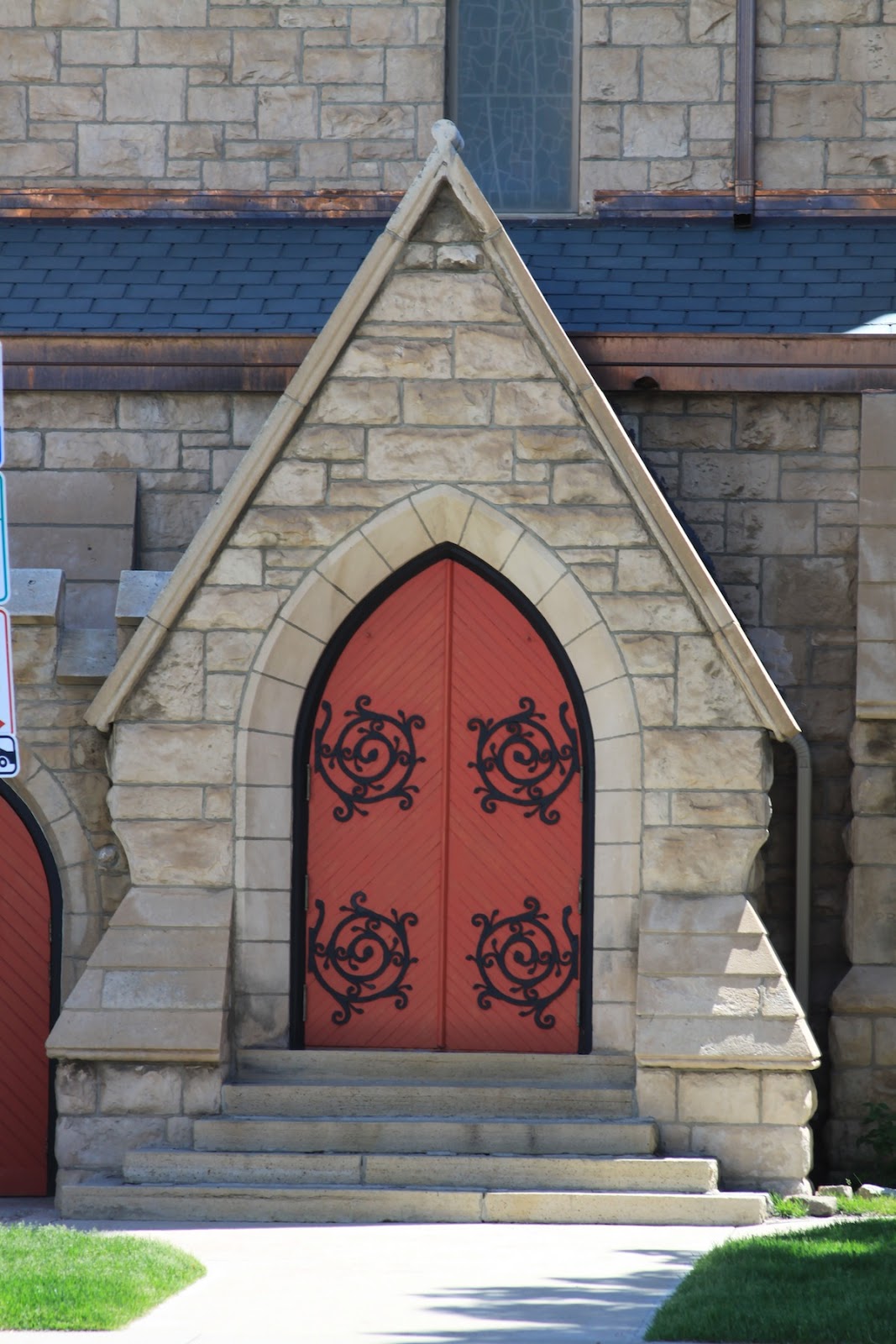
St. Matthew's Episcopal, Laramie
"Andrew," a cast member from a UK production of The Laramie Project last spring, had one more question for me as his cast prepped their roles:
I'm also playing the Unitarian Minister. I've gone to my local church the past couple of weeks and its been great! Did you know of the Unitarians? Do you have any thoughts on the dominant far right traditions of religion of the state? Baptist, Mormon etc….
Andrew,
 
It makes me laugh to look back and realize how little I knew about the far left and far right religious traditions when I was growing up.  Neither of my parents are particularly religious, although my mother made some attempt to raise me as a mainline Lutheran when I was very young.  (Since going to church also meant wearing dresses, I fought her tooth and nail.)  I didn't know a lot of religious people when I was a kid, but the ones I knew where I grew up in Montana where usually mainline: Lutheran, Catholic, Methodist, Presbyterian.  And if they weren't mainline, they were Mormon.  The exception to this rule was an uncle of mine, an itinerant vaudeville-style preacher out of the Assembly of God tradition.  It never occurred to me that he was an "evangelical" or something different from the others; I just figured he was crazy. 

I can still remember my first introduction to Baptists when I was thirteen, on the bus back from swim practice at my new home in Wyoming: 
"Hey, you!" This girl yelled at me from across the aisle. I knew her as the daughter of one of my dad's co-workers. "Do you believe in Jesus?"
"Um… sure…" I quavered. 
"And do you believe you're gonna live forever?" she continued. 
"I guess so."  Her friends were all laughing. 
"All right!" she crowed and slapped me with a high five, and I spent the rest of the drive back to school wondering what the hell just happened. 
Of course, the irony to this is that I myself became a Baptist for several years, but only after I was in college.  In case you didn't know, the church I attended in Laramie was "The Baptist Minister's" church, but I didn't go there until after "The Baptist Minister" left back to Texas.  It's also the same church that Jed Schulz attended. 

I guess this goes to tell you that Baptists were an exception to the "rules," or so I saw it, to Rocky Mountain culture.  They just don't seem to fit the rest of the society.  Most people in the Rocky Mountain region are pretty, well, hands-offish when it comes to deeply personal matters, so evangelicals and their need to insert themselves in one's spiritual lives and moral health feels very out-of-place.  So, to refer to the "dominant far right traditions" means realizing that some are more common than others, but none are "dominant" in the culture as a whole. 

As a denomination, there have been some kind of Baptists in Wyoming for a very long time, but the Southern Baptist churches only arrived in the state back in the late 1950s, all planted by the same missionary.  Therefore, while these evangelical groups are an established part of Wyoming culture, they have always been a small section of the culture, and not predominantly Baptist.  Evangelical Lutherans, Nazarenes, and Assembly of God always seemed to be more prevalent to me, but that was just my childhood impression.  

St. Lawrence O'Toole Catholic, on Grand Avenue
Actually, if you have a look at the ARDA report for Albany County in 2000, it's pretty fascinating: you discover that about 75% of the town doesn't affiliate with a home church, and that there were more estimated adherents to Islam back then than there were people holding a Southern Baptist membership.  You also discover that Catholics are the largest stated religious majority out of that remaining 25%, followed next by mainline Protestants and Mormons, in that order.  You have to take the numbers with a grain of salt, however: Catholics and Mormons [as well as Muslims] are highly encouraged to formally join local memberships while the Baptist congregations always seem to have a lot of Sunday visitors who never officially get on the membership roll.  Nevertheless, one should never mistake "non-practicing" or "areligious" with "progressive."  As a whole, the culture has very tightly held moral and social codes whether the people who espouse them are religious or not. 

So, when Stephen Mead Johnson says that both Baptists and Mormons are like "jam on toast," he's only really half right.  Mormonism is a major influence on Wyoming life (especially southwest Wyoming), and Laramie is home to a large, lavish temple building on the expensive side of town that was nicknamed "the Bellagio."   If you want to talk about the conservative traditions which have largely shaped the moral codes of Wyoming citizens, regardless of their individual religious leanings, I wouldn't pick Baptists.   With an exception for the majority's religious neutrality, we're really a mix of Father Rogers and Doug Lawses. 

As for the Unitarians: I had no idea what they were until I was well into college, and it wasn't until I went to the 2009 production of "10 Years Later" at a Unitarian church in Appalachia that I really learned to appreciate them.  It's a very tiny church in Wyoming, maybe three or four churches at the most, and I never grew up in a town that had an active Unitarian congregation until I moved to Laramie.  The Laramie UU church was my first, and I learned about it when one of my out-of-state residents when I was an RA was a practicing Unitarian.  In general, most people think of it as the "liberal church" and that it's where all the secular college professors go.  My fundamentalist roommate once referred to them as "that church that doesn't believe in God" (an unfair characterization, to be sure.) Pretty much anybody not intimately familiar with the church or their mission, I'm afraid, thinks of them more as "outsiders." 

On the flip side, the congregation has a great reputation around town for being socially active and caring people, particularly because some members of the church are professors who then also involve themselves actively in the rest of the community.  That level of cross-community involvement can be hard to find sometimes.  But just like the Baptists always seemed just a little out-of-step with the rest of the Great Plains society around them, you can say that the Unitarians are as well, but for different reasons.  The Baptists have rigid social codes that line up with Plains society, but their evangelistic roots set them apart from a private, hands-offish culture.  The Unitarians stand out because, although they embrace the "live and let live" tolerance philosophy of the Plains, they also see the social injustice in the dominant culture and constantly strive to change it.

The LDS church on 15th street, Laramie.
Both faiths are "guilty," so to speak, of a level of social interference out of pace with the culture at large: while the Baptists involve themselves with the individual, the Unitarians try to engage and change the larger social order.  As for which one had the easier time fitting in to the culture, the answer is clear: it's the conservative, highly individualistic faith that doesn't muck around with social mores.  Baptists can blend in quite well; the Unitarians, however, are always to the outside, because while their love of tolerance and non-confrontation would seem to fit the Plains character well, their interference with the established order of things is deemed more offensive to the culture at large.  

And so, while it might seem strange to put Stephen Mead Johnson and The Baptist Minister in the same boat, this is where I will leave you. 

Until next time,

Jackrabbit


I'd like to extend one last thank-you out to "Andrew" and the rest of his cast/crew for allowing me to publish these conversations.  I hope your production turned out to be wonderful. 

Friday, August 2, 2013

The UK Conversations, Part III: Minority relations

"Andrew," a member of a  UK-based production of The Laramie Project,  had some questions about Laramie life that would help him and his colleagues prepare for their roles.  The third question had to do with out patchy race relations in Wyoming: 
I was wondering if you might have a few words on the prison. I'm playing, as well as Dennis Shepard, Andrew Gomez the convict who met Aaron inside Jail. What was the Latino community in Laramie- very small? Thought of as outsiders, criminals? What jobs did they work?
In order to answer your questions on the jail a little better, I need to clarify: do you mean the county lockup, or the state prison where McKinney and Harrison sent after their conviction?  The one is in Laramie and basically a little side building next to the courthouse, but the other is in Rawlins. 

As for the Latino community, this is a question that I've been asked before, and don't feel super confident in answering, but I'll do my best.  The truth is that Laramie's Latino community was rarely thought about at all, almost an invisible population of sorts.  In fact, when I asked my husband Badger about their position in Laramie, he smirked and said, "you mean, they existed?"  That's a telling comment: even though the Latino population is the state's largest minority, they don't really "stand out," so to speak.   When I was in Laramie, I had almost no interaction with the Latino community per se on the campus, and this is where my isolation from the rest of the town makes it harder to speak with confidence.

If their treatment is anything like some of the other ethnic minorities in Wyoming, however, a lot of their status depends on whether they were born native to the region or not.  If you grew up in the region and understand its mores, you are largely accepted as part of the community, at least to a certain extent.  There's also a class difference, too: many of Laramie's minorities come in as highly educated professionals at the university and therefore have a privileged status in the community.  But those Latinos moving from other parts of the country without those credentials, and especially the 2% who emigrate from Mexico, are very much on the margins.   And, since Laramie's economy is not based on Wyoming's more prosperous mining, farming, and oil industries, that limits the number of good-paying jobs available to a population already pushed to the edges.

My sister Sparrowhawk was a foreman for a road construction subcontractor, and for a while my brother Coyote worked in the same company.  Sparrowhawk often had Latino crew members working as flagmen and maintainers. The rest of her road crew usually comprised of high school dropouts and recent parolees, if that gives you some idea of their relative social standing.  I think that many of them, like Aaron and Russ, also worked in roofing and construction.  As you can imagine, this leaves those families working these jobs in a precarious spot, especially if they have a language barrier working against them.  Construction is heavily seasonal work and often leaves people unemployed for months over the winter.  This marginalization seems all the more stark to me when you realize that the Mexican vaqueros (or "buckaroos" in my lingo) were the first and finest cowboys in North America, but to my very limited knowledge I never saw that many break into ranching around there.  

I have been told that some Native American and Latino families left Laramie after the Shepard murder because they felt physically threatened.  I can't vouch for that, but it makes a lot of sense to me.  As you may know, McKinney and Henderson were arrested initially for getting into a fight with two young men the day after they kidnapped Shepard; the cops found Shepard's identification and shoes in the truck, and that connected them to Matthew's beating.  What you may not know is that the two men McKinney attacked were Latinos.  Tiffany Edwards wrote an article on the confrontation in the Laramie Daily Boomerang after Matthew died: less than a day after attacking Shepard, McKinney pistol-whipped one of the young men, Emiliano Morales, after he slashed McKinney's truck tire.  The victim's father said that "[McKinney] would have done the same thing" to Emiliano that he had done to Shepard if he, like Matt, had been alone at the time.  Laramie Latinos, therefore, might very well have interpreted Matthew Shepard's murder as a warning against them just as much as the gay community did.  I can't confirm that this was the case.  But I could see why it might be true. 

The second reason is that our cultural landscape has never granted much of a place for displaced minorities.  Although Native Americans are also a minority in Laramie, they have a very clear place in the Western mythos; we need them to play a specific role in the stories we like tell about ourselves as a culture.  That doesn't translate to better social treatment, but they are at least recognized.  The Hispanic migrants don't have a historical role to play in our cultural memory, and that causes its own problems.   We overlook their contributions.  We take them for granted.  Sometimes we view them as dangerous.  Southern Wyoming has a very long history of bringing ethnic minorities in to work construction on our transportation lines and then brutalizing them.  If you have some spare time, just look up the phrase "Rock Springs Massacre" and you'll see what I mean. 

That's about all I have time for tonight...  I'll write again soon.   Until then,


Jackrabbit

Friday, July 19, 2013

The UK Conversations, Part II: A Lack of Hope

So, in my last post, a member of a play company in the UK, "Andrew," had asked about the overall feel of the landscape.  This was Andrew's second question to me: 
I'd be interested to know if the public at the time Matthew was in hospital were at all optimistic for his recovery. I think the doctors and family were pretty clear from early on that he would die of his injuries - did other people less closely connected to the case know that?
Dear Andrew:

 In all, I'd say that Matt's death took no one by surprise.  Everyone, naturally, was praying he would pull through, but there never seemed to be a lot of conviction to those prayers; we all seemed to know that he wasn't going to live, or if he somehow did, that he would never be whole.  You can feel that mood throughout the footage from the Newman Center's vigil: there's a flicker of hope he would survive, but like the candles, it was a small raft of light that couldn't burn forever.  If memory serves, Matt died later that same night. 

There were a lot of reasons for that despair: the media footage was dismal, and the news floating around campus was equally bleak.  Tiffany Edwards' first article on the crime from October 9th feels two steps shy of an obituary.  The school newspaper's coverage wasn't any  better.  Both of them talk about "severe head trauma" and his "critical" condition.  Even without the media coverage, basically everybody on campus had a news source somewhere, often within one or two degrees of their own acquaintance.  The faculty advisor for the LGBTA was one of the honors English professors, so there was a stream of gossip running through the freshmen honors students.  His faculty advisor was also a very popular professor in Political Science.  I think that Matt's family was also keeping in touch with his friends, and they too spread the word around.  Off campus was a slightly different story, and one I can't speak to with much conviction.  But my impression is that their mood was the same.  So many people were involved in Matt's care before he was moved to Fort Collins— nurses, EMTs, police, employees at the jail-- and naturally they talked about it.  The arraignment was public, too, and the statements made there were devastating. 

But there was one detail that stood out to those of us who grew up in the Rockies: it was the second week in October.  If you remember, I told you that the weather tends to force itself into every corner of how we live our lives, and one of those areas is our awareness of the cold.  Laramie, Wyoming sits on a sub-arctic desert plain at 7200 feet.  We have over a mile less sky above our heads than most of the United States.  Even in the summer, the nights can be cold enough to cause hypothermia; in the winter, night exposure can be lethal.  The man who killed Russell Henderson's mother, for instance, didn't need any weapon besides than a frozen county road and her stolen coat, but he murdered her just as surely.  When someone goes missing under those circumstances, we tend to keep hope on a pretty short leash. 

I vaguely remember, when I heard that McKinney had stolen Matt's shoes, I thought something like, "Oh, so I guess that's the end of it." He was left under a thin October sky without so much as a pair of shoes to keep out the frost, and for that reason I knew he was going to die.  It's strange to say this, but at the end of the day it was the theft of his shoes that convince me that Matthew's murder was a cold, calculated act.  I can't really explain why.


Jackrabbit

Friday, July 5, 2013

The UK conversations, Part I


 Sometime last school year while I was working the front desk at our university Writing Center, an email appeared in my Inbox with the following message: 
I'm an actor in [city in SE England]  embarking on rehearsal of The Laramie Project. I've been reading your blog and enjoying your insight into the town. I'd love to chat online with you about the issues around the play, and also about your experience as a Wyoming native!
I had gotten several requests for pictures thus far from different productions of TLP, but this was the first time anybody wanted to have an online exchange so far.  I sent back a reply, and I found the cast member to talked to me (who asked for anonymity and so will be dubbed "Andrew") was a pleasant and curious fellow.  What his production was seeking, he told me, was an attempt to get a sense of the larger backdrop of the play-- things like landscape, religion, and ethnic tensions, chiefly.  We had an interesting time of it.   

Andrew gave me permission to put these conversations online after their performance, and so, several months after the original performance, I'd like to do that now. 

The first conversation focused on my favorite topic-- the landscape.  Here was the first comment:   

A few topics off the top of my head- the detail of everyday life in the town. Sensually- the feel of the air, the landscape, the wildlife, the smells. The interaction between students and Laramie natives. The lay of the land- are there the snowy range mountains to the West? Can you always see them? Or is it flat plains in all directions as far as the eye can see? The hours of life of the town - a rush hour of sorts? What's the public transport situation? Socio-economic problems? And then of course anything you would like to share on the events closer to the play- the media circus, the vigils, the trials...
Dear Andrew, 


Well east of Laramie, into the pink granite mountains. 
I'll start off with your questions about the landscape. 

When I think of the landscape, I'd say that Laramie is characterized by an endless cobalt sky, yellow grassland plains, and a sharp delineation between them.  The Medicine Bow range to the west is, due to elevation differences, usually no more than a dark smudge on a golden horizon.  They really become visible only after a short drive into the open prairie towards Centennial.  These are our snowy-capped mountains— not necessarily snowy for the full year, but they stay very cold.  On the east side of town— where Matthew died— there is a steady rise in elevation up into a pink granite canyon and a slope terminating on the horizon into a pink granite canyon.  This is our main mountain range, the broken boulders of Telephone Canyon sliding up towards Pole Mountain and the Continental divide.  From our perspective, however, it is  a continuous steep slope, cut by erosion, dotted with twisted pines, and still dominated by the prairie grass.  It's beautiful in its own stark way, but quite different from the mountainous terrains most people think of.  By most outside standards, it's a place of stillness, one of quiet. 


The dominant Laramie plain.
Despite outside appearances, it is a landscape that never stays still.  Between the clouds, the wind, and the eternal shift in the weather, there is a dynamism to the environment that forces people to bend to its rules.  The storms roll through Laramie with the momentum of freight trains; you can see them build on the horizon sliding in on their own invisible tracks, just as powerful, and, after they pass with all their noisy might, just as quickly forgotten.  That the change is constant makes it easy to imagine that nothing ever changes; that we so completely accommodate our lives to the landscape that it fools us into thinking that it doesn't bother us at all. 

The town rhythms depend on whether you look at it from the inside or the outside.  I cannot speak to today— I would have to let my brother Coyote do that— but to those who grew up in areas like this, the town felt a little like a city during school sessions and a very empty place during university breaks.  Laramie has two main roads dividing the town, 3rd street and Grand Avenue, and at the conclusion of the work day, the university empties out and still clogs up the intersection every night.   Sometimes my friends and I would go grab pizza at a diner on the corner of 3rd and Grand just to watch all the  chaos when the lights changed. 

To an outsider, the traffic and speed doesn't seem all that strange-- sparse and lazy; but for someone used to small towns, it felt surprisingly "urban" and crowded to me.  In the summers, the town gets quite still, somehow slower and more intimate, more like a close-knit community.  Since I've left, however, summers are taking on a life of their own; much like Fort Collins, the town has cultivated more of an artisan and craft culture, and now the quiet summers have markets and festivals which shut down the old downtown area with booths, music, food, and artwork.  It's pretty neat. 

In my years there, Laramie had no real need for a bus system because I could bicycle anywhere in town in under 20 minutes, even in a blizzard.  The new Wal-Mart and eastward expansion of the town has changed that, and I think there's now a single bus line running down Grand Avenue.  (The Wal-Mart bought another newfangled concept to Laramie, and that was an acceleration lane.  Most of us had never seen one.)  That was one of the real charms to living in Laramie, as a person who grew up in a working-class family deeply tied to the land: I could pick a direction, and, in less than an hour on my bicycle, be the only person for a mile in any direction.  After week after week of crowded dorm life and deadlines, I needed distance from our quasi-urban university life to reacquaint myself to the land.  Laramie could provide me with that. 

In my head, I imagine that is exactly what Aaron Kreifels was doing that morning: he picked a direction and rode on his bike to get away from other people for a little while so he could just focus on a deep blue sky and that that three-inch strip of prairie running between his tires.  And that's where he found Matthew. 

I'll leave off there for today.  Let me know what else you'd like to talk about, and I'll be happy to answer. 


Regards,


Jackrabbit

Monday, July 1, 2013

Measuring the time

How does one measure the time?  It has been a strange two years for me, which I am still trying to figure out.  Originally, the things I needed to sort out in my head brought me back to the foot of Telephone Canyon, and so I blogged on Laramie, and TLP, and LGBT acceptance as a way to sort them through.  Then came the shift: I have had other things on my mind, and it has led me away from blogging for awhile-- things like, do I really want to finish this Ph. D.?  Am I willing to bail on this career if it it's the only way I can go home to the Rockies?  How do I balance the dictates of a full-time career and a chronic disease, both of which tend to make ridiculous demands of my time and energy?  These questions have taken me away from the blog and elsewhere, and it was hard to justify continued academic interest in The Laramie Project when, according to my prospectus, I'm an Anglo-Saxonist.  Then I looked up to find that two years were gone. 

Life has a way of going in circles, however, and the last few months are bringing me back here.  For one, Grandpa Wolf, my last surviving grandparent, died in May.  I missed the last week of classes to fly back for his funeral in Montana and the return trip brought me back to the land I miss and the family questions I can't escape.  My nieces, who never knew Grandpa Wolf in the days of teeth and claws, were devastated to lose their great-grandfather.  I envy them a little-- they only knew him in the good times.  I still remember the broken bones, the fur and feathers. 

In a weird way, I almost feel like I understand him better now that he's gone.  I can look beyond the old man I hated in my youth and pitied in my adulthood to see at him more objectively.
Church steeples of the high plains: at Lewistown
From the old stories the locals told and the papers in his cabinet, I learned that Wolf was an "accident" baby, and after a traditional German shotgun wedding his parents hopped the border as far as Ypsilanti, North Dakota to escape the infamy.   I also learned that the US Army took my desperately claustrophobic, tractor-driving farmboy of a grandfather and made him a tank driver in the Philippine campaign in World War II.  How he survived the terror I will never know, but he never drove anything smaller than a Cadillac during my lifetime.  His mother died shortly after he was injured overseas, and so he came back from the Pacific Theater covered in scars from the napalm burns, now the main breadwinner for the two younger siblings which his teenage sister had taken under wing.

As I marked the decades between the grain silos stretching from North Dakota to Montana, the more Grandpa Wolf made sense-- he isn't excused, but at least I can fathom how he came to be the man he was.  Wolf was brought into the world as the "mistake" that led to a hardscrabble, loveless marriage between second-generation German immigrants; they came to Montana in the hopes of starting their own farm, only to discover their land wasn't arable.  During the Depression, they labored on another man's land until Grandpa Wolf lost his father when he was ten and his mother a decade later.  When the draft came calling, the Army stuffed him in the smallest hole they could find and waited for him to go crazy.  I'm fairly sure that Wolf's own father was an abuser.  Without anything else to hold onto, he slipped down the same road: insecure, obsessive-compulsive, and violent.

Grandpa Wolf's hometown,  population 125.
It doesn't end there, however. Something else has happened between those decades stretched out between the grain silos.  My mother Goose wanted to hold the reception at the senior's apartments where Wolf had lived up until last year.  I listened to the stories the old timers had about him, and I was perplexed.  This Wolf was personable, easygoing-- even sociable.  He could laugh at himself.  He actually had friends.  There was no way this man, who was once awarded a medal for "lady chasing" by one of the wags at the seniors home, was my grandfather.  Or was he?

I eventually realized that, in the decade that I swapped snow fences and sagebrush for magnolia trees, things had profoundly changed.  The last four years since he lost my Grandmother had utterly wrecked him.  He was not yet a "good" man, whatever that means; but he was trying to become one.

In the last year my mother took care of him at their home in Wyoming, as he could only eat through a gastric tube.  I would have thought that a year of taking care of the man who terrorized her as a child was my idea of hell;  My Mama Goose, however, confessed to me that she was glad she did it.  The man she buried in Lewistown, Montana was not the same one who wrecked her life, she said.  Spending all that time with him, caring for his feedings and medication, convinced her he was different.   And, while he was still far from perfect, she insisted, he was forgiven.   If it weren't for his illness, she might never have known-- and she never would have had closure.  

*      *     *

With all these things on my mind, I sat in the Casper Events Center next to my sister Sparrowhawk as I waited for my niece Kestrel to cross the stage as a certified high school graduate.  She's now eighteen and raring to fly the coop-- in fact, she reminds me so much of my sister at eighteen it's a little scary.  One of the co-valedictorians gave a fairly bland speech that made me fuzz out in boredom.  Then the second girl delivered her speech: she referenced Harvey Milk's courage and sacrifice, and the Stonewall riots, too, if I remember correctly.  My sister smirked and leaned in confidentially.  

"You see her?"  She said, indicating the orator on the stage.  "She had the worst crush on Kestrel in middle school."  This was said without disgust or discomfort, as it would have been just fifteen years ago.  It was simply a fact, one of many others as she reminisced about the other young men and women who walked over the stage-- who played games in her living room, or had their scraped knees bandaged in her kitchen, or were best friends only to grow apart in their teens. These were wistful memories for her, of happier times before the tension started and Kestrel, as beautiful and strong-willed as her mother, began to slip away. 

My sister has never been one to forget a wrong, but she has turned her powerful memory into something more useful than before: a way to mark change.  Even so, I don't know if she realizes how far she has come in the last fifteen years in her acceptance of gays and lesbians, even if her own daughter thinks she is still "back in the Stone Age."  If I use my own memory to mark the change, I can see it, too: slow, easy to miss, but still significant.   

And maybe the same can be said of a town where an eighteen-year-old lesbian graduating from Matthew Shepard's old high school can speak of Harvey Milk in front of her peers, their parents, and the Superintendent of Schools, and still walk out with both her pride and diploma in hand.  

Maybe.

~~Jackrabbit

     /\ /\
     || ||
     \|_|/
     /. .\
     \_Y_/
      

Friday, June 21, 2013

An open letter to Alan Chambers

In case you hadn't heard, the head of the nation's largest "ex-gay" ministry, Exodus International, announced that they would be closing its doors and offered an apology to the LGBT community for the damage they caused. You can watch the video below if you haven't seen it. 

For those of you who don't know, a friend of mine committed suicide after six months in a ministry affiliated with Exodus.  After mulling it over for two days, I felt the need to speak. I originally wrote this for an acquaintance, and now I am passing it on here.

~~Jackrabbit


Dear Mr. Chambers:

 Last night I read your apology after Exodus International shut its doors, and I was surprised at my ambivalence. For almost seven years I wanted to have this conversation with you. I have screamed at you in my mind in church. I have sparred with your shadow in my prayers and fought with you in my sleep. In the face of all the things I thought I would have wanted to say in this moment, I find that my anger is gone. The Lord, ever the reconciler, has long since settled the cold war between you and I; you are no longer the bogeyman I made you in my mind, and that has left me confused.

Instead of all the things I once wanted to say, I feel I have to tell you about James-- lean, lonely James, with the ice blue eyes and Jude Law good looks. His nervous, ecstatic energy, an infectious smile and irresistible charm. Manic as hell. An addictive personality that clung to things like static, cracked blue sparks at a touch. Like everything else in James' life, he craved God in ways only drowning victims comprehend: the cold, burning logic that says fill your lungs, swallow in the breath of Life or die. He was something to behold.

Wednesday, October 3, 2012

The Tectonic Uncertainty Principle: Now for Jackrabbits!

So, fall is here, and that mean that the theater season is well underway. How do I know this? Because I can watch the page counts on Flickr and Blogger tick upwards, like a little barometer, with people looking for pictures. 

It's a surreal feeling, actually.  My ultimate goal was to help people interested in The Laramie Project, sure, and I was aware that my stuff might actually end up in productions of TLP.  Sure, I always new that.  But now that I see it happening on more than just one or two productions...  Just, wow.  It feels strange.  On the one hand, it's nice to know I can help people out, especially with getting a fuller view of the Laramie community for their performances.  On the other hand, I'm having a bit of an identity crisis with this.  I've always been ambivalent about the buck fence as a symbol of torture and death, and now it seems that I have unwittingly helped people further this very discourse.  

Ladies and Jackrabbits, this is officially the most popular
picture I've ever taken.  I'm not sure how I feel about this. 
Let me show you what I mean.  According to Blogger, in the last month, three of the five most popular posts are the ones on the fence where Matthew Shepard was killed: namely, "The Buck Fence and Place," "The Fences of Laramie," and the second post of my "Fences" series.   My post on Matthew's memorial bench actually rounds out the top four.

It's not just a new trend, either.  The stats are historically largely the same for as long as Blogger has offered free site statistics.  A large number of people come to this site specifically interested in buck fences. 

To give you an idea of what that breakdown is, here are some lifetime stats on page views for my blog via Google Analytics:

Tuesday, September 25, 2012

Coming Back Again

It's been a long year, friends.  It's time for the Jackrabbit to come back.

Dissertation writing is a funny thing: when it doesn't go well, you think to yourself, "I  just need to have more discipline to write on this." When I wrote on this blog, I felt guilty that I wasn't writing about early medieval dog-headed saints from Scythia.  And so I stopped writing here.  And in doing so, I stopped writing altogether.  That's how I learned a long, painful lesson:  You must write.  And if you smother the things you want to write at the expense of the things you must, you stop up the flow altogether.  I got the prospectus done-- eventually.  Now I must write chapters.  And if I am to write chapters, I have to unstop whatever it was I held back before, so that the words will come again. 

I don't know how much I'll actually be able to get back here and write-- but I figure that at least once a month is not too much to ask of myself.  And I hope I'll also have some help.  We'll see. 

So, a few things have happened in the last week or so that have made me decide that I need to start writing again.   The first (and exciting!) thing is that I have officially, finally passed my prospectus defense.  I had my defense last week, in an enormous conference room around a tiny table while four medievalists absolutely grilled me about codicology.  They were all very impressed with the work I did, I'm proud to say.  But then I asked them an important question:  "Do you think I can finish this by the end of the Spring semester?"

They all looked at each other, and my dissertation director shook his head.  "There's not a chance," Dr. H told me.  I looked to my paleography professor, and she just shrugged.  It looks like I am not graduating in the spring no matter how hard I work on this stupid dissertation.  So, if I can take my time, I figured, I might as well write. 

The next day I ran into "Jim" from our local performance of "10 Years Later" back in 2010.  I hadn't seen him in almost a year, even though we work in the same building, because he has new administrative duties in the Theater Department on campus.  I ran into him on my way to my shift at our Writing Center.  It was immediately as if time had never passed. 

"How are things going, Jackrabbit?"  he asked me.  I squirmed a little because I knew I hadn't been working on my blog.

"Oh, pretty good," I told him, and explained that I'd finally passed my prospectus defense.  He was pretty elated for me and even asked me to email him a copy of my prospectus.  I had to run because I was running late, but seeing a friendly face from my TLP past stuck with me for the rest of the afternoon.  

Then, tonight, this happened on Facebook.  I have a colleague whom I'll call "Rebekah," who posted this:


The short version is that I reacted rather badly to this.  I realize that expecting my undergraduate students to openly pay attention to things that happened before they were in school is a bit much, especially when they haven't been in the news.  I know that Matt Shepard doesn't get the press he did before the Shepard-Byrd Hate Crimes Act passed.  But really...?  As much as gay rights have been in the news in the last three years, none of them had heard of Matt Shepard? 

I'm still not sure how to react.  On the one hand, cultural memory follows a strict law of entropy; those things which do not actively impact cultural events die a slow heat-death and fade into the neutral background of the past.  And in many instances, that's a very necessary process for healing.  There have been times, especially when I was still an undergraduate and living under the long, black shadow of a buck fence, that I wanted it do disappear from memory, too. 

But now?  I realize that what I wanted to fade was the pain, not the name of someone who unwittingly became the focal point the greatest culture war of my generation.  And, in that ambivalence, I also realized that there's more to write. 

I don't think that The Laramie Project is finished with me.  Not yet.  So, maybe it's time for me to come back. 

Besides, I still have two performances I need to write about.  Their stories need written, too. 

Tuesday, November 29, 2011

Just... two more days...

And I will be a functioning member of blogging society again.  Hooray!

In the meantime, I am well on my way to finishing the prospectus, and will be back with you shortly.

How's the writing going, you may ask?  Kind of like this:


On the other side of the coin, it's getting done. And that's the important part!

~~Jackrabbit

PS:  In case you were wondering, the other "Jackrabbit" gave her dissertation defense yesterday, and I am excited to report that she is now officially "Dr. Jackrabbit."  I couldn't be prouder of her.  Way to go, my friend!  

Friday, November 18, 2011

Six Things my LGBTA Taught me About the Gospel, part 2

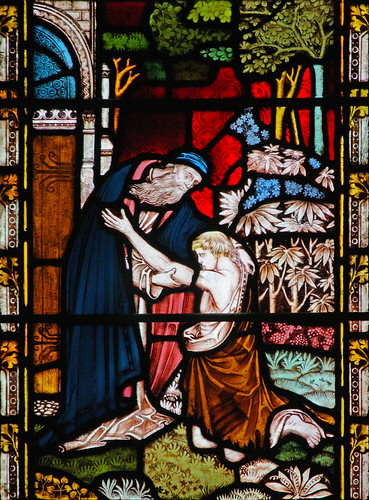
Return of the Prodigal Son
I spent a couple hours last month experiencing something absolutely incredible: I was given the opportunity to talk with a loving Christian woman who struggles with the fact that her adult daughter came out as a lesbian two years ago.  She had initially reacted badly to her daughter's confession, and for a time their relationship was shattered.

It took a lot of forgiveness on both sides, but they are on speaking terms now.  However, their relationship had stalled.  She had so many questions about what her daughter was going through, but she needed an interpreter to translate the Christian perspective through LGBT eyes and back again to show her why her overtures for a deeper reconciliation were getting rebuffed.

As we began speaking, I told her about Matt Shepard's death and James' suicide, and what that had taught me. Then I told her about all the wonderful things I was learning from the LGBT community, and I saw such a transformation in her body language as she moved from frustration and loss to real empathy.  For me, seeing that woman's love for her daughter break out unfettered by her suspicion of and frustration with the gay "lifestyle" was absolutely humbling. 

We had scheduled for a one-hour conversation at a local college ministry, but three hours later we left with a hug and a promise to check in with each other again.   She said she felt ready to pray for the well-being and safety of the entire LGBT community and to take a stand against hate in her church.  And, she said with some trepidation, she might even get the courage to meet her daughter's partner and be civil-- but she's not quite ready for that yet.  She still needs a little more forgiveness and time, as we all do, but I feel confident that their relationship is on the mend.  

So, as I finish out my list of lessons I have learned from the LGBT community, I wanted to end with the different perspective that the LGBT community has regarding my faith community, in the hopes of showing why so many well-intentioned evangelicals stumble around on two left feet when interacting with the LGBT community. And so, without further ado...

 4.  If we're all supposed to die to the self, then why do I have to go first?  

Tuesday, November 15, 2011

Stop the ride, I wanna get off...

I love you Dr. L, I really do, but I feel like I'm arguing in circles with a congested, fatalistic turtle called "Prospectus."
Any pointers?

 So, I have a doppelganger in the English Department here who is also named "Jackrabbit" and is a year or two ahead of me in the PhD program.  When I passed my last exam, I was literally skipping down the hall when I ran into her at a desk in our computer lounge.

"Congrats on passing your specialized exam," she told me.   

"Thanks!  It feels so good to be ABD (all but dissertation)!"  I chirped.  "It's all downhill from here!"  She shifted her baggy, exhausted eyes from the disorganized pile of her chapter revisions on her desk to me with baggy, sleep-deprived eyes full of pity. 

"Jackrabbit, I love you and all, but don't you realize?"  She begged.  "You're done with the easy part.  The hard part is just starting.  This stupid dissertation is going to put me in my grave."  And thus, having completely deflated my naive, cheerful buoyancy, she turned back to her revisions with a groan.

"Oh," I answered.

 It only took a month to get to the same point that my friend the other "Jackrabbit" already was at.  I am officially done with the emotional toll of graduate school, and I haven't even finished my stupid prospectus yet.  I'm all for calling it "good enough" and rolling on with the rest of my life. 

Wipe that grin off your face and help me with a thesis
statement already, Falcor.  I'm desperate.
Unfortunately, my dissertation committee, like a certain stodgy turtle from an old movie from my childhood, has other plans.   One of those plans involves another three semesters in school and a grinding, hopeless weight that's pulling me underneath like Atreyu's horse in the Swamps of Sadness, and I'm still waiting to get pulled from the muck by the sudden arrival inspiration with big wings and floppy ears.  Stupid Luck Dragons-- never around until the last possible second.  I mean, look at that face; he's mocking me, I swear.

Some of my colleagues are a lot worse than me right now, however.  In the last month I've had three different PhD candidates crying on my shoulder in despair, and this afternoon I made a freshman burst into tears just by asking her about her paper topic.  To top it all off, yesterday I stepped on a roofing nail and drove the thing almost an inch into my foot, so I earned a visit to Student Health for a free tetanus shot.  Winter vacation in Wyoming absolutely can not come soon enough.   

What that means for blogging, however, is that I'm going to have to shift from regular posts and research on TLP temporarily to more of an ad-hoc basis.  Although, if I'm honest, that's been what I've been doing since April anyhow, so nothing will really change that much on everyone else's end.  It does mean, however, that I won't get near as much progress done on keeping up-to-date with everything as I would wish, but, hey, at least we'll keep rolling.  And, if anybody has a contribution they'd like to add, or advertise an upcoming "Project," or point me to something cool, I'll certainly have the time for that.

And so, do not despair, I am still fully committed to blogging!  I should have a few posts up over the next week and a half.  I find that blogging is a relaxing way to procrastinate from writing a dissertation proposal.  Just as long as Dr. L doesn't find out...  


Sunday, October 9, 2011

Aaaaand I'm off!

I'm about to head out to the Maryville College production of The Laramie Project, and I think a few of my friends from the outreach center will be there as well. 

I'll let you know how it went sometime in the near future.  Wish me luck!

Scholarship: Social Impact of the Shepard Tragedy in Academia

If you're a literary person, you're probably like me and can't believe how few literary, scholarly articles there are actually out there on The Laramie Project.  If you widen your scope to documentary theater or work on Tectonic in general, the net gets wider, but few people in my field are tackling this play as a text or performance like any other drama.  The social and historical angles of the play, perhaps, are  taking precedent in the scholarly imagination.

On the flip side, though, that means that other disciplines are interested in Matthew Shepard and The Laramie Project as well-- and they're writing about it.  This past week I found some fun, interesting, and melancholy reflections across the disciplines.  I found doctors, psychologists, archaeologists pedagogy experts all reflecting on the tragedy and the play, and each of them sheds a little light on the social impact both Matt and Tectonic Theater had on America in the previous decade.  Here's a list and shot description of some of the most interesting I found.  Enjoy!


Blackburn, Mollie, and J. F. Buckley.  "Teaching Queer-Inclusive English Language Arts."  Journal of Adolescent and Adult Literacy, 49.3 (2005): 202-212. 

Charles, Casey.  "Panic in the Project: Critical Queer Studies and the Matthew Shepard Murder."  Law and Literature 18.2 (2006): 225-252.

Dunn, Thomas R.  "Remembering Matthew Shepard: Violence, Identity, and Queer Counterrepublic Memories."  Rhetoric and Public Affairs 13.4 (2010): 611-652. 

Hoffman, Scott W.  "'Last Night, I prayed to Matthew': Matthew Shepard, Homosexuality, and Popular Martyrdom in Contemporary America."  Religion and American Culture 21.1 (2011):121-164. 

Hurst, James C.  "The Matthew Shepard Tragedy: Management of a Crisis."  About Campus 4.3 (1999): 5-11. 

Noelle, Monique.  "The Ripple Effect of the Matthew Shepard Murder: Impact on the Assumptive Worlds of Members of the Targeted Group."  American Behavioral Scientist 46.1 (2002): 27-50.

Saewic,  E., and S. Marshall.  "Reducing Homophobia in High School: The Effects of The Laramie Project Plays and an Integrated Curriculum."  Journal of Adolescent Health 48.2 (2011): 111.

Friday, October 7, 2011

Upcoming "Projects": Maryville, TN, this weekend!

How did I not know about this sooner? 

Source: www.maryvillecollege.edu
The Laramie Project is returning to Appalachia!  A small college within driving distance of my home in Appalachia is doing a performance this weekend.  It will be a small affair, involving both college students and community members.  The director of the performance is interested in the ethics of performing real people: 

Dr. Heather McMahon, associate professor of theatre at Maryville College, said she selected the play for a variety of reasons.

“For one thing, the play is a challenge for actors, since all cast members will play a variety of roles,” McMahon said. “Each actor must differentiate the characters from one another so that the audience can see the townspeople of Laramie, Wyo., come to life. Because the play represents real people, there is an even greater responsibility to do justice to the characters.”


What makes this performance stand out to me is that Maryville College is a religiously-founded institution with Presbyterian roots, so their interpretation of events should be really interesting, I hope.  I'm really hoping I can make the trip to go see this this weekend with some of my friends.  It would make such a nice point of comparison for the Duke performance (of which I still need to talk about, I know.)

You can read up on the performance in the Knoxville News Sentinel here, or at the theater's website here

 
Location:  Clayton Center for the Arts, Maryville, TN

when:  Thu, Oct 6 thru Sun, Oct 9, 2011
where: Haslam Family Flex Theatre
time:   8:00 PM Thurs. through Saturday, 2:00 PM Sunday

Thursday, October 6, 2011

The Matthew Shepard Effect

You often hear of the positive effects of Matthew Shepard's story on other people, but not a lot of people get on YouTube to explain that in a video. A friend of mine posted this on his webpage, and so I wanted to share it with you. 

YouTube vlogger Denactor created this post to give his reactions to-- and appreciation for-- how Matthew Shepard's death impacted his own life, starting at age twelve, to a closeted teen, and now to an outspoken gay adult.  It's an interesting trajectory to see in one guy's life. 

Such are the power of stories-- even the horrible ones, like Matt's murder-- for they teach us about who we are.


Wednesday, October 5, 2011

Six Things My LGBTA Taught Me about the Gospel, part 1


SURGEON GENERAL'S WARNING 
FOR THE STAUNCHLY SECULAR: 
This post gets kind of preach-y at other Christians.   
Proceed with the Jesus talk at your own discretion.

So: this year marks the start of my third year with the LGBTA as the random, straight evangelical who hangs out with them at meetings.  Usually, when I talk to other Christians about why I'm there, they think that I'm walking among my gay brothers and sisters from some moral high ground and I'm giving them moral instruction.  Nothing could be farther from the truth.  The fact is that they have taught me more about how to be a Christian than I think I ever did in my six years in the SBC.

It's not that I didn't learn a lot about God in the SBC; they supported me through my first years as a believer, and though their higher organization grieves me a lot, they still deserve some credit (or blame?) for making me who I am.  It's just that I learned more about this whole Gospel thing by walking with my gay friends than I ever did by running with the holy rollers.
 I have learned some great lessons from the wonderful people of my Appalachian chapter of the LGBTA, the outreach center on campus, and especially one specific professor, who is one of the coolest people on my campus and a good friend.  And so, let me share a few of those lessons with you.  So, if you're not of a particularly religious bent, feel free to skip this post, and I'll see you in a week or two.  Here we go!

1.  Jesus came to save the world from the religious.  So should we.  

Tuesday, October 4, 2011

October's Aphorism of the Month, courtesy of Nothing Profound

So, it's October once again, and with it has come the first cold weather here in Appalachia, the changing of the leaves, and the end of our midterm cycle. 

For me, though, it's also a bittersweet month.  It makes me think of Laramie thirteen years ago.  It makes me homesick, and it makes me think of Matt.  With all this in mind, I picked this aphorism to guide the blog for this month, as always, courtesy of Aphorism of the Day

Leaves, while they live, hang together;
dying, they fall one by one.

Thanks again, Marty, for giving us something to ponder.  

Sunday, October 2, 2011

I'm back!

Finally! 
With the conclusion of my final graduate exam just a short while ago, I am officially less busy than I've been recently. 

I also passed my oral exam!  I am officially ABD (all but dissertation,) and I have been declared competent enough in my field to write 200 pages of nonsense.  Something about Anglo-Saxon geographic and spiritual identity, or something. 

The bad news is that I now have to write a dissertation proposal in the next three weeks, so I'm not out of the woods yet.  But I do have time to reconnect with you all in TLP-cyberspace and start blogging again. 

So:  in order to start my return off with a "bang," I want to highlight an important new source for research on The Laramie Project for play productions and researchers, but this time it's not a what-- rather, she's a whom.  I'd like to introduce you all to Susan Burke, who started this past summer at the Shepard Foundation as their new Laramie Project Specialist.  Here's a little blurb from her profile on the Foundation's website:
Susan attended the Graduate Acting Program at the Goodman School of Drama in Chicago (now The Theatre School at DePaul), and has strong backgrounds in theatre, journalism and Matthew’s story. At the time of Matthew Shepard’s murder, his funeral, and the trials of his killers, she was the Executive Producer/Senior Anchor for the evening news at KTWO Television. Based in Casper, KTWO-TV was the statewide NBC affiliate, and it was Ms. Burk’s primary responsibility to arrange and implement coverage for all of these events, including community reaction and response. She produced a series on the making of The Laramie Project film that won the top news awards from both the Wyoming Associated Press and the Wyoming Association of Broadcasters that year. She is based in Casper, Wyo.
Wow: Susan is a woman of many talents who was also personally involved in Matthew Shepard's story.  Her job is to make intersect with the Laramie Project theatrical community and make your life easier.   And, plus, she's a wonder person to talk with.  She and I have communicated with each other a little bit by email and I have found her to be an engaging and upbeat person with a lot of great knowledge.  I would completely endorse her as a "must see" source for TLP for a wide range of questions. 

If you're interested, take a look here at the Shepard Foundation's website, and contact the organization for more information on the help which Susan Burke can provide. 

It's good to be back.  And it's even better to be back with a new supporter/research buddy to share the same adventure with! 

~~Jackrabbit


Friday, September 9, 2011

Upcoming "Projects": Camarillo, CA, 2012

The first director to take me up on posting comes from Camarillo, CA, where a new production of TLP is in its earliest stages.  Jolyn Johnson's production isn't until April 2012, but it sounds like a little help from the larger community would be useful:
I'm currently studying all I can about TLP and Laramie itself. I'm directing the show at Camarillo Skyway Playhouse and auditions are in January, but I wanted to get the word out early. Recently, I attended our county's PRIDE Festival to spread the news to the LGBT community. I called and spoke with a member of Tectonic Theater as well as contacting the Matthew Shepard Foundation for resources.
I still feel like I'm not quite there yet, that I haven't found the truth of Laramie. I want to know all about these people and this town, about the hard times and the hope. If anyone has information they could pass to me since I sadly lost my dramaturg, it would be greatly appreciated! Photos, stories of the *people*, anything to show my rather conservative community what really happened in Laramie. Our show goes up April 13-May 13, 2012. I'm excited and honored to be the director of TLP; I only hope that I can do it justice.
 Good luck moving forward, Jolyn, and I hope to hear about your progress as the play moves into full production. 

Wednesday, September 7, 2011

Calling all Theater companies!

Oh, for the time to blog again! 

I ask you to forgive the long, long pause in the progress of "Down the Rabbit-Hole" recently.  Like most PhD students, at set times in my life cycle I tend to hibernate in dark, gloomy caves (read: libraries) and only come out for fresh air and coffee.  Now is one of those times. 

With only one comprehensive exam standing between me and the much-coveted "All But Dissertation" status, I have been hunched over the books for the last two months trying to cram as much random crud about medieval geography in my head as possible.  The process is much like trying to cram clowns into a Shriner's car, and just as messy. The exam is in about two weeks.  I ask for prayers for stamina now that I've been forced onto a caffeine-free diet. 

In the meantime, it pains me to see this blog lying fallow when I know that there are dozens of TLP productions getting started right this semester.  Right now dramaturges, directors, designers and actors are asking hard questions about how to stage this play, and why.  There are actors starting to feel the serious emotional demands of their roles.  Wouldn't you like a place to talk about it and to see how others are dealing with the same issues?

Since I don't have time to write until my Prospectus is done, I'd love to hear from others about their current and former TLP experiences from any part of the production process!  If nothing else, tell me about your production and I'll put up a post to advertise it.  If you want to bare your dramaturgical soul about how much you love Brecht's "Street Scene," I want to hear it. 

All interested parties can contact me at jackrabbit.blog@gmail.com  and I'll be delighted to post them.  Take care, y'all!  Drink some coffee for me.