
So, what does this level of cold on a sub-arctic plain smell like?
Vaguely of copper, actually.

 Do you ever get really bizarre dreams when you're really preoccupied with something? I usually only get weird dreams when I eat pizza right before bed, but anyhow...
 "Where's the fire extinguisher?" I shrieked in panic. "Everything's catching fire..."Why are you so worried? his eyes said to me. That's about when I woke up, for my husband was trying to get me out of bed to get ready for church.
"We don't have one," he drawled. In my dream, I felt my heart skip. My mind was still full of rioters and flames and panic.
"What do you mean you don't have one? Every damn floor in this building is supposed to have a fire extinguisher," I yelled. That old man didn't even bat an eye at my mounting panic but glanced at me curiously.
"I don't know, I think you're crossing the line between ministering to the lost and promoting," he answered. I'm pretty used to comments like that. In our circles, it's okay to love gay people as long as you make it very, very obvious that you disagree with their "lifestyle." Whatever. My minister friend knows better, too, but old habits die hard.
"It's not like I'll be standing at the door handing out condoms," I replied. "I'd just be there to keep the door open for the students and answer the phone."
"But, why? What are your goals?" he insisted. After some pretty intense discussion about sexuality, culture, and my opinion on what exactly "promoting" meant, I told him, "Look, there's only one word in the LGBT community for a straight person, and that's 'Ally.' I have to take that seriously." He cautiously agreed with me. But he was still a little worried.My next stop, the following day, was to meet with "Andy," one of the two ministers who had helped me with the street-preacher protest. We had a long, long conversation. It has been neat to see "Andy" grow into the idea of laying down the traditional Christian defenses to just minister to gay people's needs like everyone else. Actually, he's actually grown rather passionate about it. "Torben" was out for the afternoon, so Andy and I had a long chat on our own.
"So, what do you think about volunteering?" I asked "Andy." He shrugged.He didn't see the need to necessarily volunteer at the center for what I wanted to do, but he was fine with the idea nonetheless. Wow. A year ago that would have been unthinkable.
"Honestly, Jackrabbit? You have to open yourself up to the possibility of making mistakes. You're in uncharted waters. If this is your conviction and it's wrong, you'll learn later. But if it's what you think you need to do, you can't be afraid to do it."
To some degree, Laramie is indeed presented as a latter-day Grover's Corners, a cozy place where everyone appears to know everyone else's business and actually finds comfort in this. But if ''The Laramie Project'' nods conspicuously to Wilder, this play is ''Our Town'' with a question mark, as in ''Could this be our town?'' There are repeated variations by the citizens of Laramie on the statement ''It can't happen here,'' followed immediately by ''And yet it has.''--Ben Brantley, New York Times
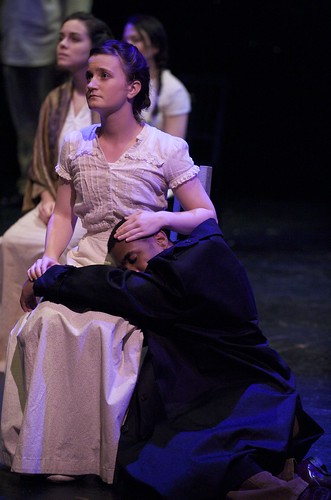 But the reason that Our Town worked as an embodiment of the universal human experience was because it had an aura of utopia-- it seemed to be a "good place" [eu-topia in Greek] that reflected all the best parts of the American dream (and some of its problems) at the turn of the previous century. But, more importantly, for all its specificity and regional connection to New Hampshire, it was a "no-place" [ou-topia] that had no specific cultural coloring other than the ones which Thornton Wilder wanted it to have. Grover's Corners was a symbol; it was a specific but fictional community existing at coordinates well off the map of America which could hold all of the nation's ideals and faults in the same space and reflect them back on the culture as a whole. That was Wilder's genius: the landscape is American and it's real, but the specific location is not.


